It had seemed that the developers wanting to build the tallest ever building in south Bristol were going to have to go back to the drawing board. In January this year, a planning committee of councillors refused a proposal for a 23-storey block of student flats in the Victorian inner-urban district of Bedminster, still largely characterised by low-rise residential terraces and light industrial uses. Members had voted 5-3 against the scheme – a high-density mix of 400 Purpose-Built Student Accommodation (PBSA) units, 434 Build-to-Rent flats and commercial floorspace. As the council’s procedure dictates, officers were instructed to come back to the following meeting with written-up reasons for refusal. The councillors had refused the planning application on the grounds of over-intensive development and townscape harm, including to the setting of the Grade 1 listed heritage asset St Mary Redcliffe church. There was also the issue of poor design: 55% of rooms do not meet the British Research Establishment’s guidance for sunlight and more than half the proposed units are single-aspect. Other concerns included the over-concentration of student accommodation in the area and a letter from the NHS warning that local GP practices were already operating at or near capacity and would be “unlikely to be able to accommodate the increased demand arising from this development.”
But what came back to the following meeting was an officer report that told the committee that they couldn’t, in fact, refuse – not without the developer taking the council to the Planning Inspectorate for an appeal that would be certain to succeed. And the council’s Chief Planner, Simone Wilding, raised the stakes further in the meeting by saying that the council would be likely to lose around £750,000 in appeal costs, plus a further £250,000 through the expense of defending the case.
Thanks for reading Temple Scenes! Subscribe for free to receive new posts and support my work.
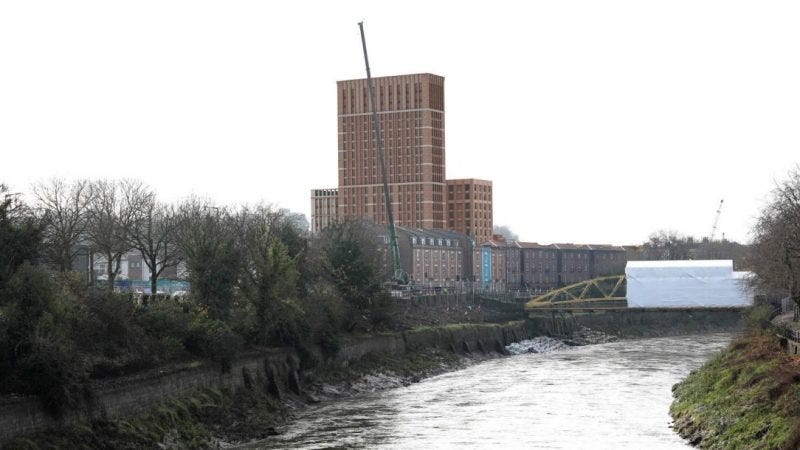
To illustrate the Planning Inspectorate’s supposed willingness to overturn refusals based on over-densification, the attention of councillors was repeatedly drawn to a development in Brighton that had a refusal overturned at appeal last year. In the initial committee meeting, when Wilding brought up ‘Brighton Gasworks’ – a mixed-use residential scheme with buildings ranging from 3 to 12 storeys – she made the false claim that it was “a much higher density” than the proposal before them. In reality, the reverse is true: Brighton Gasworks is 245 dwellings per hectare (dph); Princess Street is 384 dph if you don’t include the student tower, 427 dph if you do. Both Princess Street levels exceed the threshold identified in London planning debates as ‘hyperdensity’. Nevertheless, the Chief Planner went on to tell the committee categorically: “We haven’t got a policy on density on which we could refuse this.”
This wasn’t enough to deter the committee first time around. But when the explicit threat of huge appeal costs was made at the second meeting, a majority of councillors voted to approve the scheme. The two councillors that swayed the decision stated that the fear of appeal and a huge costs award was a reason for their decision, despite the fact that, in law, planning decisions must be made solely in accordance with the development plan unless material considerations indicate otherwise. Fear of appeal costs is not a material planning consideration and so can’t be used to justify granting or refusing permission. And while members may be advised on appeal risk, costs awards are set at a high bar: they require “unreasonable behaviour”, not simply a decision the Inspector disagrees with. Here, it would need to be because the decision lacked credible evidential or policy support. Yet officers were able – when asked – to produce a detailed three-page analysis for the second meeting that identified a range of conflicts the Princess Street scheme has with specific policies. The figure provided for costs also appeared grossly exaggerated: very large costs awards are extremely rare, and there is no reported case of a local authority ever facing one as large as £750,000.
None of this mattered ultimately. The Chief Planner’s threats worked and the message was driven home that the ‘planning balance’ as interpreted by Bristol City Council means that the “benefits” of large-scale, speculative development – specifically purpose-built student accommodation and build-to-rent flats – will outweigh any concerns about local character, design quality, affordability or pressure on local services. And crucially, that elected representatives do not have the powers to oppose them.
It also underlined the fact that local communities will be disregarded too. Not only were more than 450 public objections submitted, but the council’s own loud promises of local consultation shaping regeneration through its strategic planning framework for the area, have proved to be largely meaningless. The Whitehouse Street Regeneration Framework was published by the council in 2023 and claimed to be so alert to local perspectives that it included a ‘Community Manifesto’. The manifesto’s top priorities were avoiding excessive building heights and overdevelopment; delivering genuinely affordable, community-focused housing for all ages; and retaining some of the current light-industrial employment. The opposite has been delivered. Every local stakeholder group involved in the production of the manifesto strongly objected to the proposal that has now been granted planning permission. And their concern that the height of the buildings shouldn’t block the panoramic view of the city centre from the top of Victoria Park – so well established that it’s marked by a permanent viewing plaque and draws people from across the city on summer evenings – has been so egregiously ignored that it must feel like mockery.
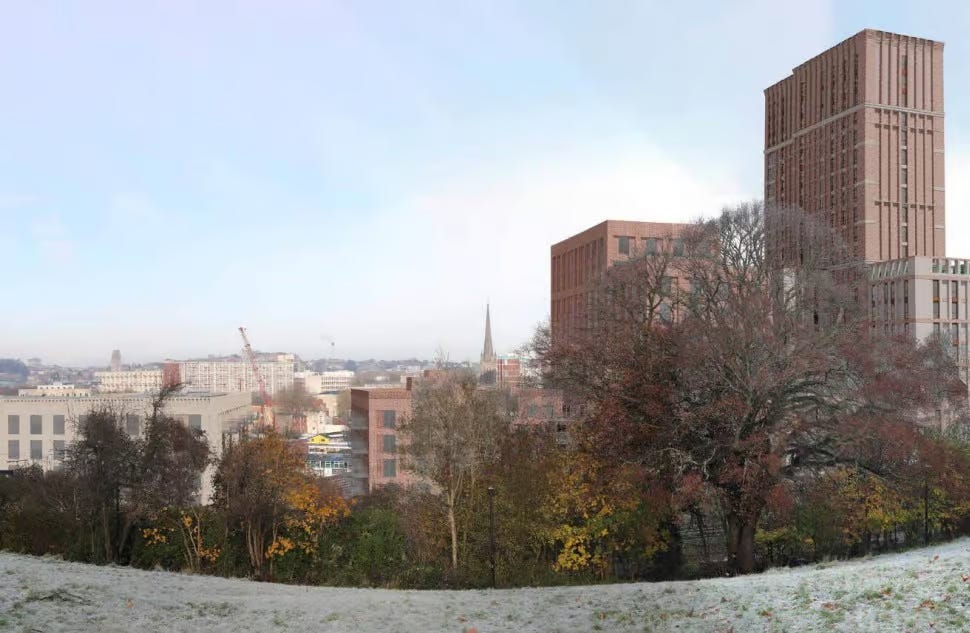
To further justify the officer recommendation to approve, councillors were given a list of factors currently constraining the development sector in Bristol. They were told about the combination of higher construction and land costs, higher interest rates, and the implications of the Building Safety Act – a response to the Grenfell tragedy that requires two stairwells for buildings over 18 metres and reduces the amount of rentable/saleable units in any one block. All these challenges to viability, councillors were told, meant that the 20% ‘affordable’ flats on offer for the Princess Street scheme could only be provided through the profits secured by a huge PBSA tower.
Sitting in a separate asset class to standard residential development, PBSA (and increasingly, ‘Co-Living’, a similar model of high-density, high-rise housing aimed at young graduates) has proved a highly attractive proposition in major UK university cities for investors. Not only more cost-effective to build, they’ve promised secure, long-term yields, based on increasing numbers of affluent overseas students, the undersupply of student housing and the vastly inflated rents that these cities are already afflicted by. The rapid expansion of the two universities in Bristol over the last decade – nearly a 50% increase in student population, largely driven by overseas students – means that the undersupply of student accommodation can never be caught up with under the current developer-led model. Indeed, it’s that undersupply that underpins investor returns. And this creates the darkly ironic situation whereby the city’s housing crisis is used to justify facilitating the expansion of its biggest driver, while doing nothing for British students who are increasingly unable to afford the exorbitant costs of PBSA, and all radically changing the scale and character of the city with bland high-rise blocks.
Chief Planner
The forceful, and at times misleading, role the Chief Planner plays at planning committees, as she attempts to convince councillors to vote in line with officer recommendations to approve major developments, demands deeper scrutiny. Wilding was brought into Bristol City Council in 2023 under the aegis of Stephen Peacock, the former Executive Director for Growth and Regeneration who had recently become Chief Executive. After his arrival at the council in 2019, Peacock – whose professional background spanned the oil giant BP, the telecoms sector, the South West Regional Development Agency and corporate consultancy at Grant Thornton – drove a series of planning reforms under the mayoralty of Marvin Rees aimed at accelerating development, centralising decision-making power and diminishing the independent influence of the council’s City Design team through its absorption into a new centralised planning structure. The local state would also be commandeered to play an active role in this process by ‘de-risking’ projects through offering generous leasehold deals on publicly-owned land (the council is an unusually large landowner in the city) and using public money for site-enabling works prior to construction.
Following the restructuring of the planning service and the creation of the new Chief Planner position, Peacock and Rees brought in Wilding in 2023 from senior management roles at the Planning Inspectorate – and earlier positions in private consultancy and the South West Regional Development Agency alongside Peacock himself – to lead the reorganised department, centralise planning control and tackle the severe planning backlog that led the government to place Bristol into special measures in 2024.

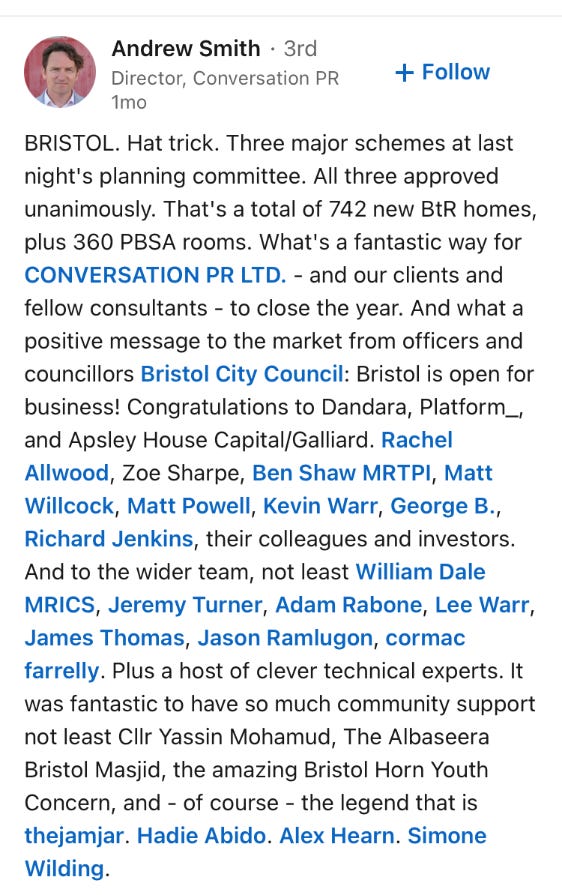
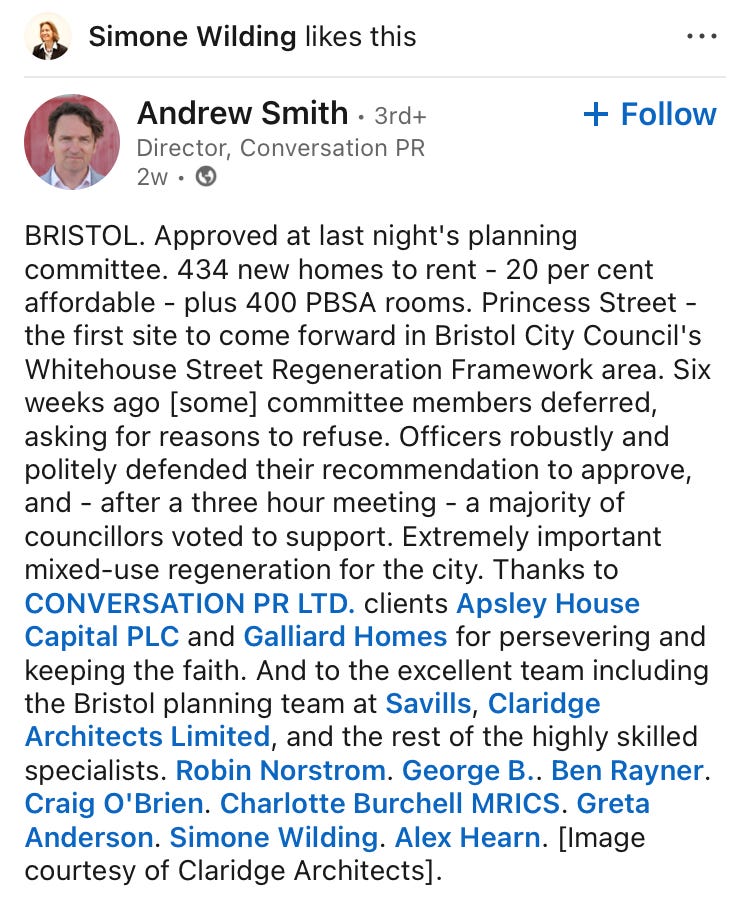
A revealing insight into how she understands her role and the close nature of her relationship with the developer community in Bristol is provided by her use of the professional networking site LinkedIn. Following the Princess Street committee reversal, Wilding went onto the platform and, as she often does, ‘liked’ a post by the public relations lobbyist working for the developers of the scheme. The post had celebrated the planning consent and thanked her, along with others, personally:
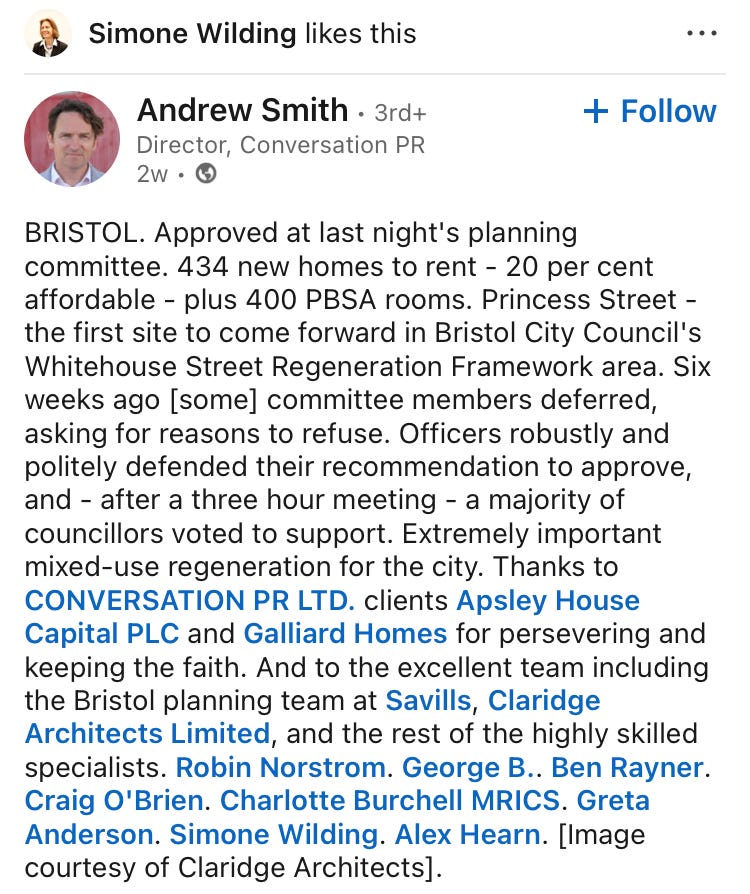
What emerges from these interactions is a powerful sense that the city’s Chief Planner operates less as an independent arbiter – weighing competing interests in the public good – and more as an embedded partner within the city’s ecosystem of development professionals. As the examples that follow demonstrate, she presents herself to these private interests as collaborator, ally and even social companion; working to create a shared narrative on how development in the city should happen. And we can see LinkedIn functioning as another part of the shadow planning system – another domain outside formal democratic governance structures where the future city is shaped.
Glittering Prizes
For the professional managerial class, LinkedIn is an online ‘safe space’ away from the unruly energies of other social media platforms. It’s a zone where boosterism, networking, virtue signalling and corporate platitudes reign supreme and unchallenged. A place of relentless, self-serving affirmation, as job moves and promotions are announced, loyalties signalled and industry prowess displayed.
Beyond a smattering of posts and comments that appeared during the years that Wilding was a senior manager at the Planning Inspectorate, it appears from the activity visible on her account that she only began using the platform in earnest when she took up the post of Chief Planner at Bristol City Council in May 2023. Many of her interactions are with the myriad developers, agents, architects, lobbyists and PR professionals that make up the development ecosystem in Bristol.
One of the striking things that emerges is her frequent physical presence at industry social events where these development professionals gather, particularly dinners and awards ceremonies. On the 24th April 2025 there was the annual Insider South West Residential Property Awards, a black-tie dinner at the Mercure Bristol Grand Hotel. Insider Media described the event as including “the full gamut of residential housebuilders, place-makers, planners, architects, consultants, advisers and lawyers who have been involved in the region’s most exciting deals and developments.” Wilding acted as one of the judges on a panel that included Nikki Davies of Meeting Place, the Bristol-based planning communications and PR consultancy.
The following month, in May 2025, the Bristol Planning Law Dinner took place in the Landsdown Suite at Ashton Gate stadium. It’s clear from this post by Freddie Palmer, a planning consultant who also works for Meeting Place, that the firm invited Wilding to it and that she was given a seat at their table.
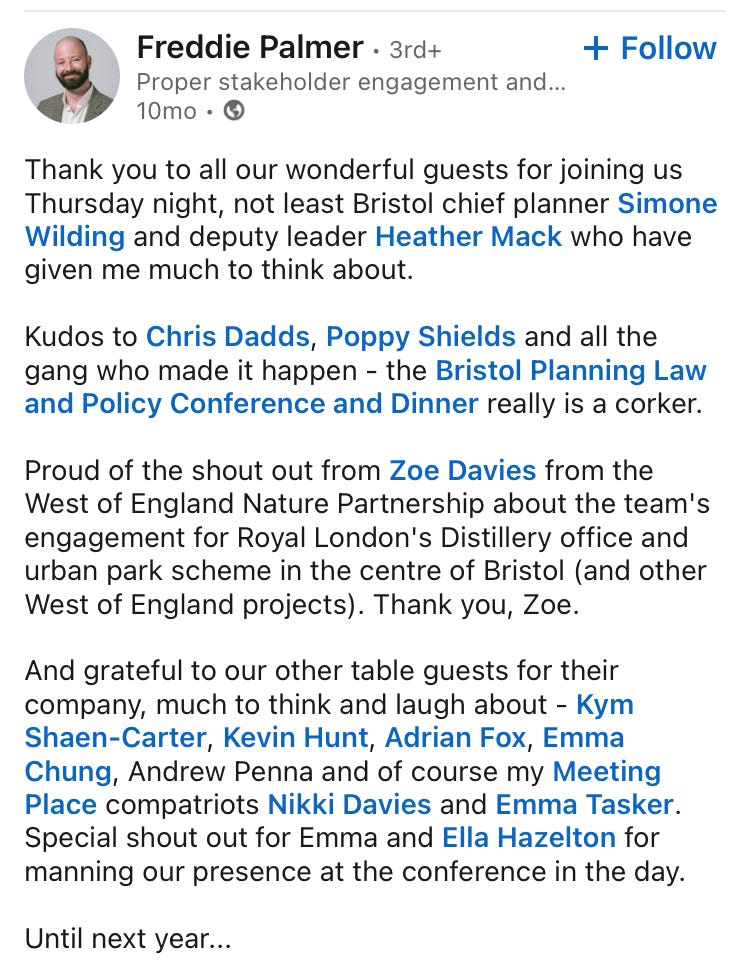
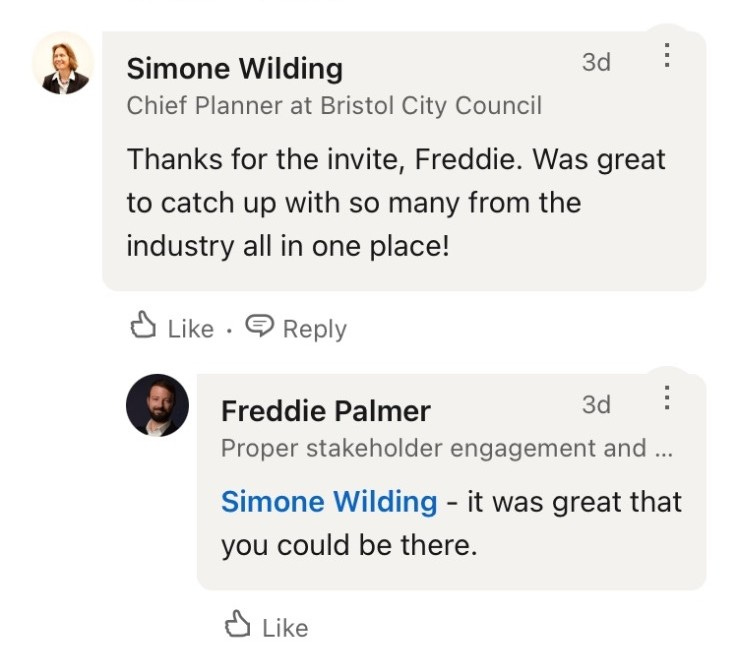
Palmer worked as a consultant on the Princess Street scheme and spoke at the second planning committee meeting in support of the application.
Also at the table was Emma Chung, who works for JTP, a placemaking architectural practice that designed the controversial Baltic Wharf development. This harbourside residential scheme was overseen by the council’s arms length housing company Goram Homes, but is being built by the private developer Hill Group. Part of the controversy centres on the fact that 74 mature trees on the site are being lost.
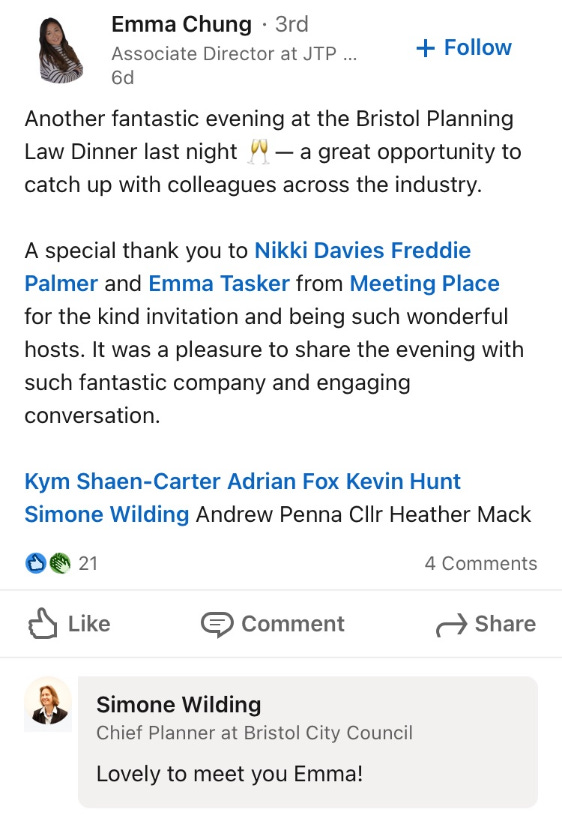
Baltic Wharf was approved in 2024 as a scheme that would include 50 social rent flats to be owned by the council. In July 2025, a change in planning permission was granted that removed the obligation for affordable housing to be provided as part of the scheme after the developer claimed viability issues. Instead, an unspecified amount from Homes England, the government’s housing and regeneration arm, would facilitate the social housing element through a Housing Association. The project has also received £2.4m of public money from the government’s Brownfield Land Release Fund grant for site-enabling works. The developer is currently marketing it as an “exclusive collection of luxury waterside 1–3 bedroom apartments in the heart of Bristol.”
Also in July 2025, and just a short walk along the harbourside, Umberslade, the owners of the mixed-use Wapping Wharf scheme, and their development partners Muse, held a party to celebrate 10 years since the original development opened. Wilding was in attendance.
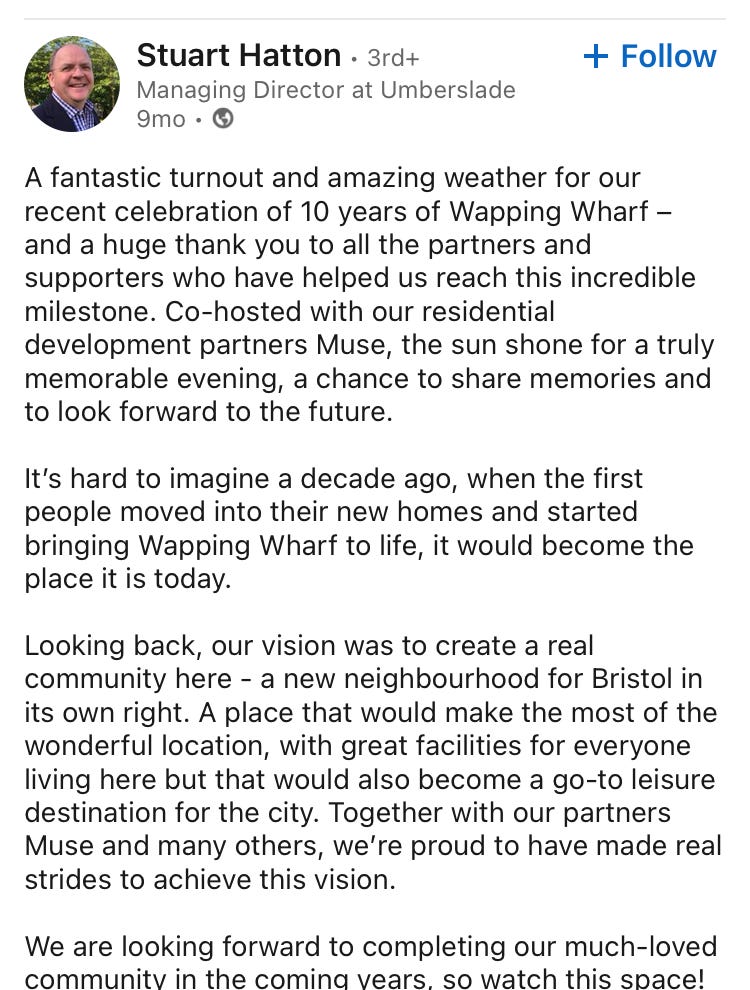
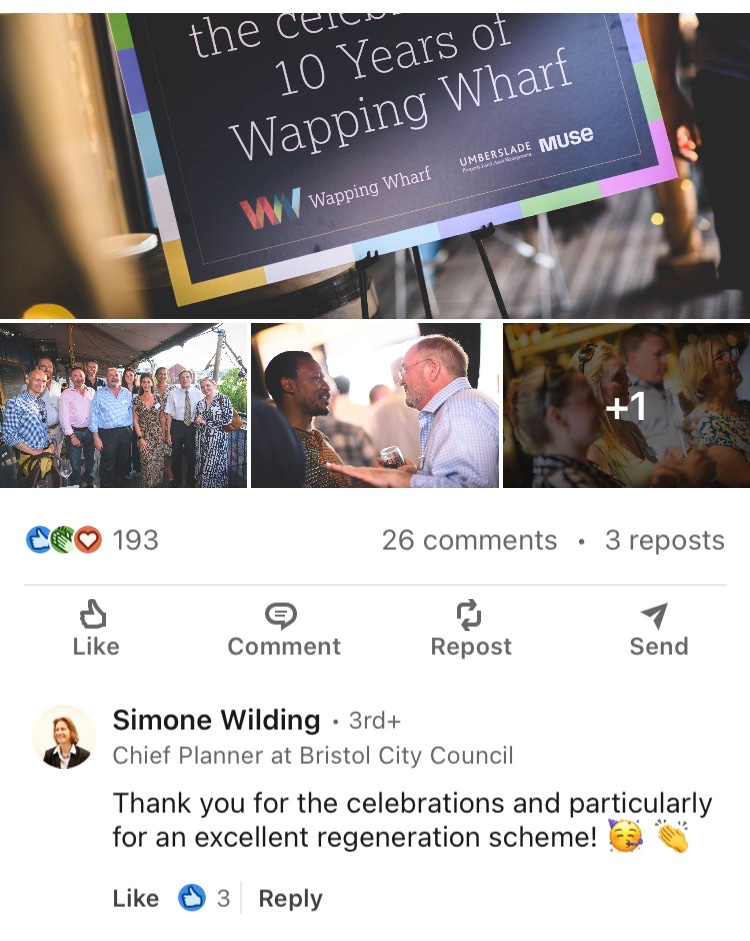
Umberslade and Muses’ planning application for a new scheme on the Wapping Wharf site – 245 flats plus retail/commercial space, replacing the popular Cargo container market with a high-density development scaled up to ten storeys – was at that very time being assessed by the planning department. It came to committee with a recommendation for approval around seven months later in February 2026. Wilding’s comment here drew a ‘like’ from the director of Development Management at Muse.
The summer of 2026 will bring more glitz. On 4th June, Wilding is appearing on the national stage as a judge for The Planning Awards at Savoy Place, London. A recent email sent out by the organisers advertised tickets at £280 a head (plus VAT), with the subject line “Network with the industry elite”. Describing the event as “the most prestigious night in the town planning calendar”, the first reason provided for why people should attend was: “Connect with high-level decision-makers from the biggest organisations in the business including our judges”.


Simone Wilding Likes This/Loves This/Celebrates This
Wilding’s tone on LinkedIn is generally highly enthusiastic and she distributes a regular flow of congratulations under posts by Bristol-connected development professionals announcing a new job or promotion.
Congratulations to Matt Tucker becoming a director at Savills. Congratulations to David Grattan becoming a director at Grattan Planning. Congratulations to Julian Seymour becoming Deputy Chief Executive at Cratus Group. Congratulations to Rhian Jones becoming Urban Design Assistant at Marrons. Congratulation to Alex Cave becoming Land and Planning Manager at Wates Developments. Congratulations to Pete Gladwell becoming Group Managing Director, Public Investment, at Legal & General. And so on.
A more subtle form of signalling is the use of the various ‘reactions’ – to ‘like’, to ‘love’, to ‘celebrate’.
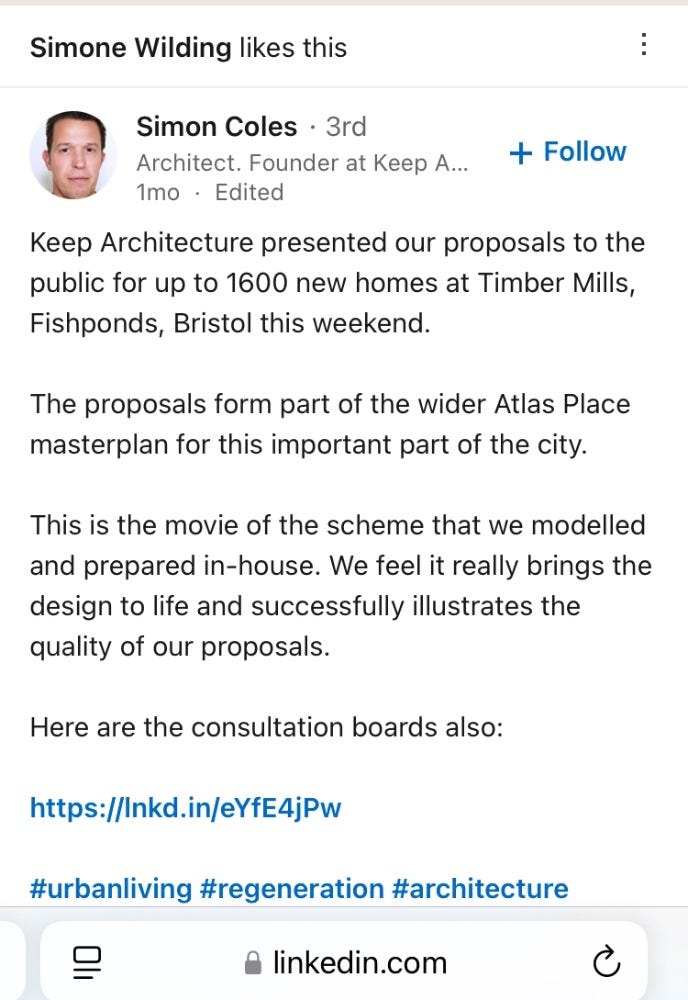
Here is a ‘like’ from March 2025 for the architect of Timber Mills, the largest component of the Atlas Place regeneration project – three separately owned former industrial and commercial brownfield sites in Fishponds that are being lined up for more than 2,000 homes. The Timber Mills proposal hadn’t even been publicly consulted on at this point, let alone submitted to the council as a planning application. But that didn’t stop the Chief Planner communicating her approval.
On 30th March this year, the Atlas Place Fishponds Strategic Framework Vision came to the council’s Economy and Skills committee to be endorsed as a material consideration in planning decisions for Central Fishponds. This is an entirely developer-created document and was presented to councillors by Kevin Hunt from the planning consultants Turley and Michael Cowdy from the place-making studio Moowd.
Sitting in front of them, Wilding was asked a question from the committee about whether there was a chance the local community might feel misled by the framework, particularly around height and density, as they had with the Whitehouse Street Regeneration Framework. She replied:
“It’s more important to consider the quality of the public realm and the quality of the living conditions that’s being created, rather than specific numbers around density or height and numbers of storeys. The difficulty with such numbers is you can get very hung up on them and ultimately they don’t really have that much meaning in terms of the quality of the place really being created, and that’s why we’re keen not to have them.”
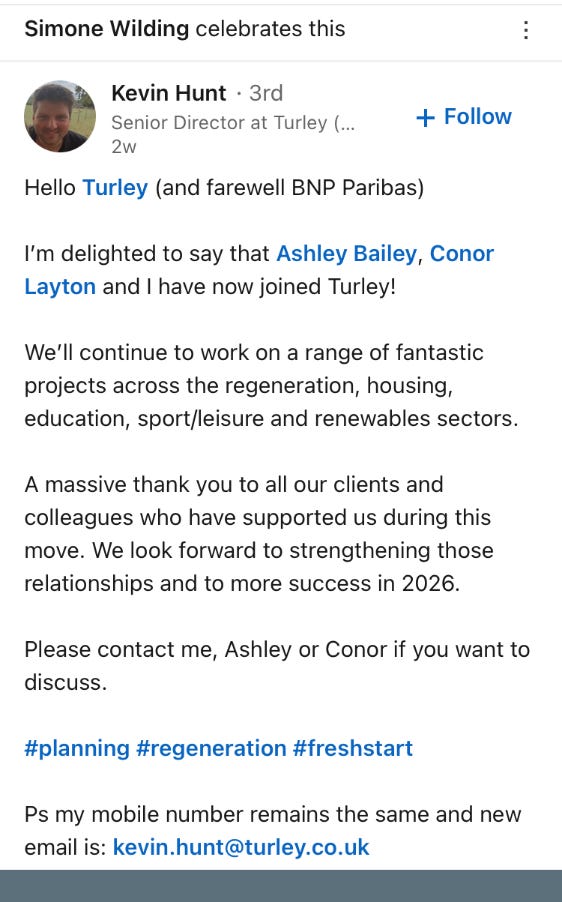
Michael Cowdy nodded behind her as she spoke. In January 2026, Kevin Hunt – a former planner at North Somerset council – had announced his move from BNP Paribas Real Estate to Turley on LinkedIn, which Wilding had ‘celebrated’.
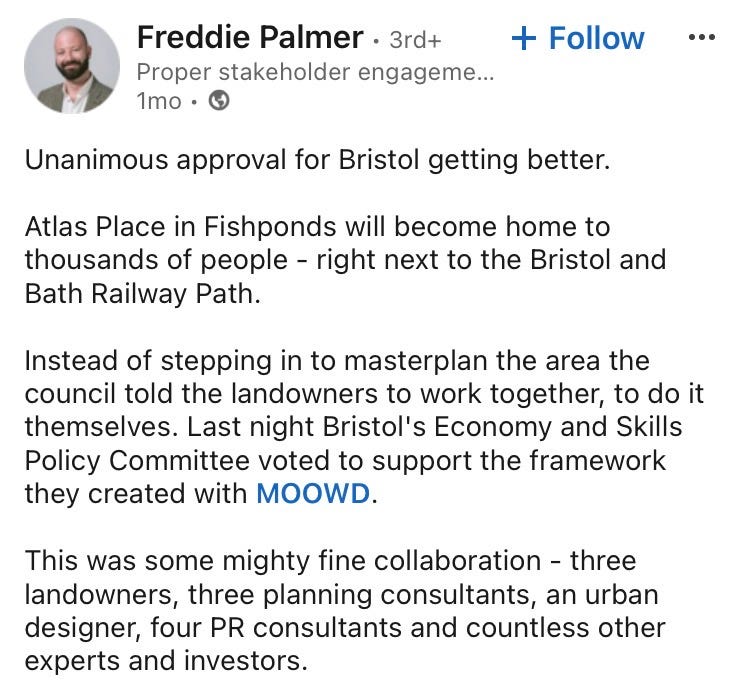
Freddie Palmer from Meeting Place is also involved with the Atlas Place regeneration project. On LinkedIn, he hailed “some mighty fine collaboration” in the creation of the framework, with the council telling the land owners “to do it themselves”. The work required no less than four different PR consultants.
No Tricks: The South West’s Most Successful Lobbyist
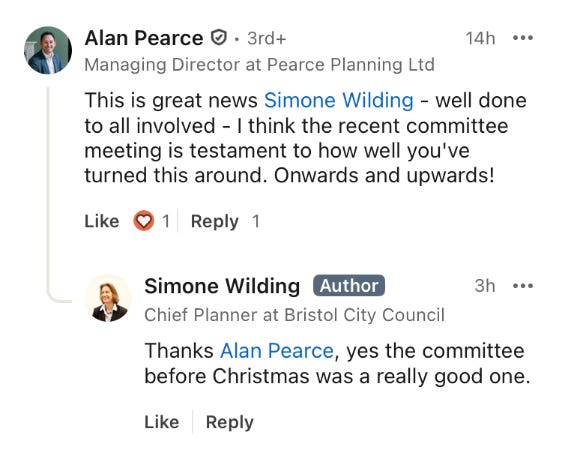
Development professionals on LinkedIn regularly voice support for Wilding’s approach directly to her. In this instance, the managing director of Pearce Planning – consultants based in Clevedon – celebrates the planning department being removed from ‘special measures’ and then refers to the committee meeting in December 2025 that saw three schemes of Build-to-Rent and PBSA approved in line with officer recommendation.
But of all the Bristol development professionals on LinkedIn, nobody engages the Chief Planner as energetically as Andrew Smith. He is the director of Conversation PR, and describes himself as “a former political aide, journalist and FTSE 100 communications director.” His lobbying firm – which “helps developers secure planning consent”, to quote the first line of his LinkedIn profile – have been involved with many of the biggest schemes in and around Bristol over recent years.
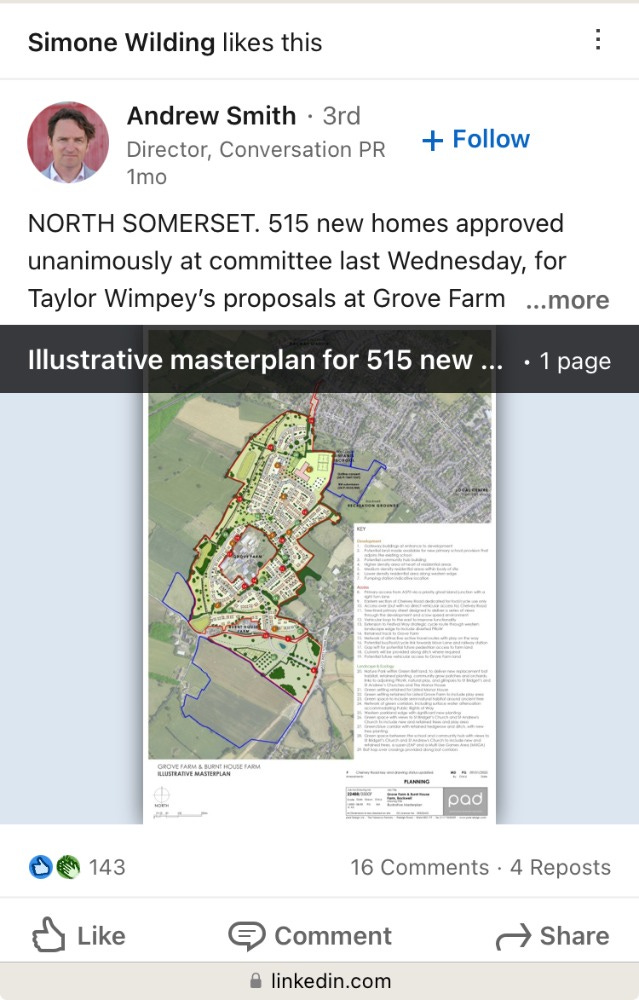
In March 2025, Wilding ‘liked’ this post trumpeting planning permission being granted for a development by the volume housebuilder Taylor Wimpey, although it isn’t even located in Bristol, but on the edge of Backwell, North Somerset.
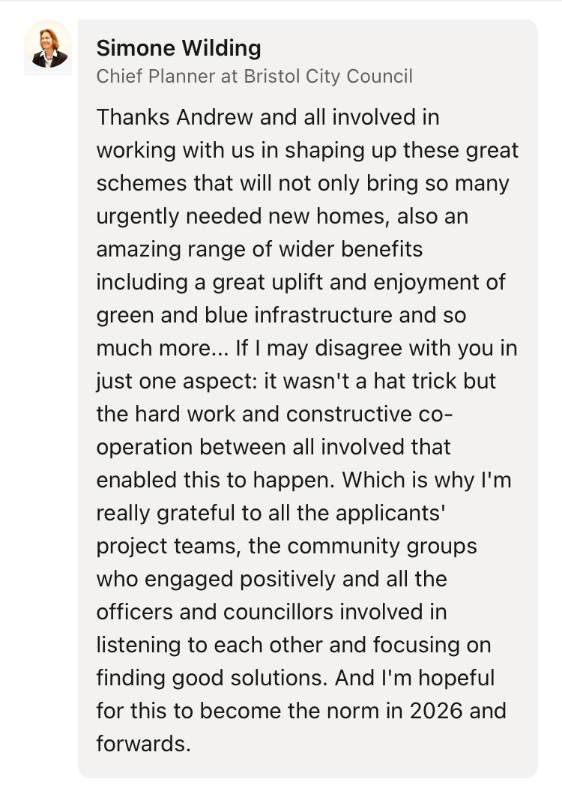
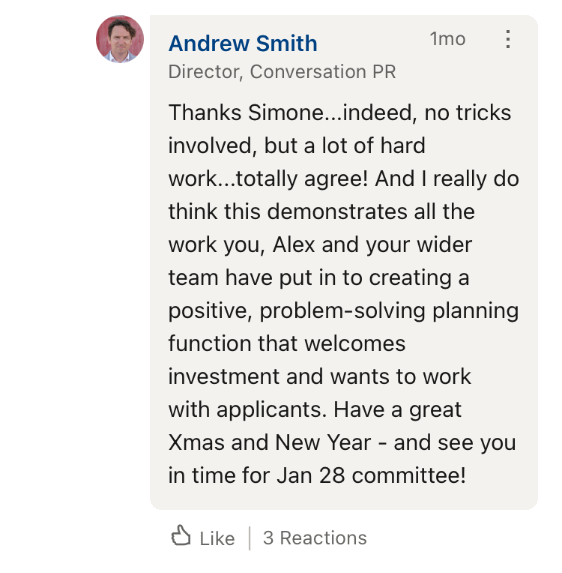
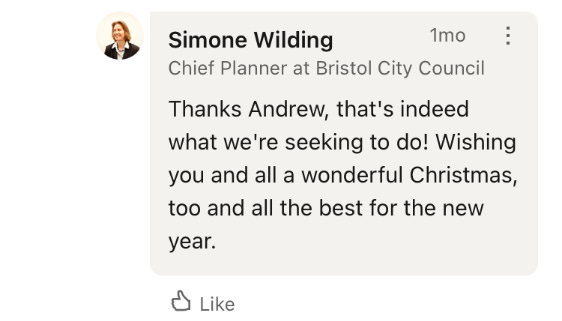
In this exchange from December 2025, Wilding appears to misunderstand the meaning of the phrase “hat trick”, and unnecessarily goes on to labour a point about “hard work and constructive co-operation” (as opposed to tricks) before sending fulsome Christmas good wishes:
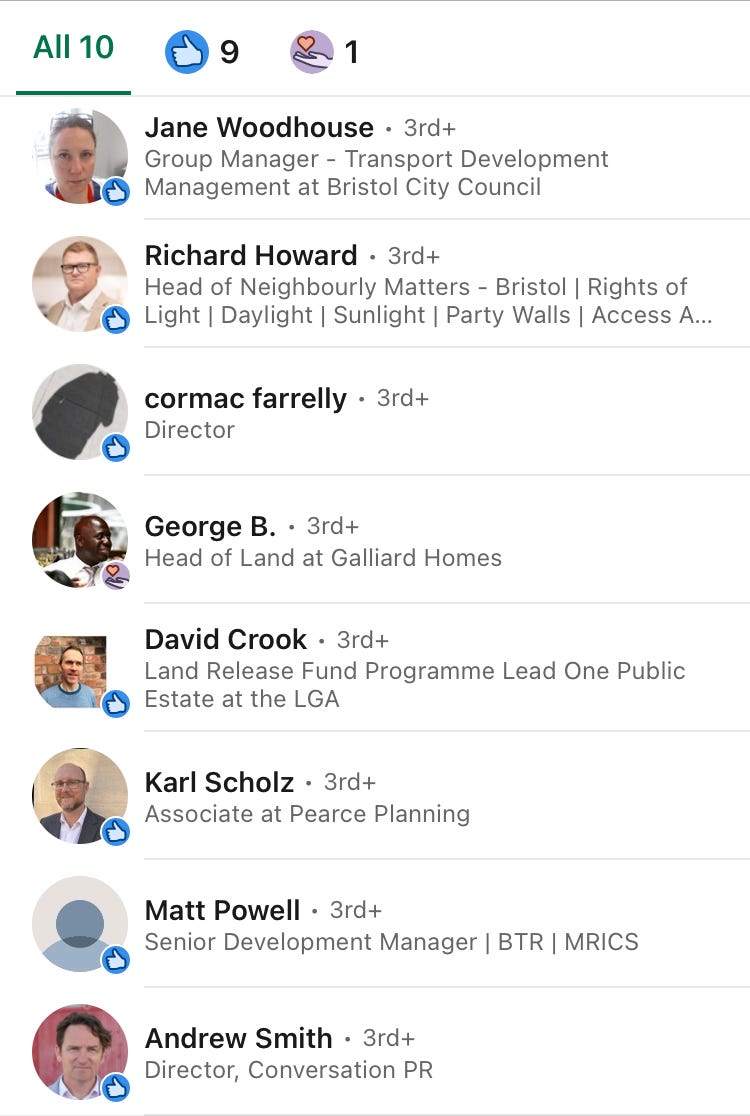
This comment received ‘likes’ from various development professionals. George Baffoe-Djan, Head of Land at Galliard Homes, went one better with his reaction and proffered a heart on an open palm (‘support’). Galliard Homes are the co-developer for the Princess Street scheme along with private equity firm Apsley House Capital.
Smith responded to Wilding’s comment:
The pair were back at it after Christmas. In February, Wilding posted an article titled ‘London’s Shortfall, Bristol’s Breakthrough’ by the Offsite Alliance, a construction industry coalition that lobbies for offsite building methods. After outlining London’s failure in recent years to get anywhere near its ‘affordable’ housing targets, the piece celebrates the fact that “Bristol delivered 286 affordable homes between April and September 2025”. This was only 59 more ‘affordable’ homes than were built over the same period in 2023, but the piece hails it as “a significant breakthrough”. And goes on to make the hyperbolic claim that, “Bristol shows what is possible when a region manages to break through longstanding barriers.”
With around 20,000 households still on the waiting list for council housing and more council homes still being lost to Right to Buy than are being built, the suggestion that these modest figures are making a meaningful impact on the housing crisis is clearly fanciful. The ‘affordable’ tag itself, of course, includes many properties that are shared ownership or discounted market rate rent, in a city with one of most overheated housing markets in UK. The longstanding barriers that prevent people in Bristol from finding genuinely affordable housing are still very much in place.
Recent developments on council policy also undermine this narrative of progress. In February, a ‘Viability Addendum’ was added to its Affordable Housing Practice Note which allows developers to reopen negotiations over affordable housing commitments (and thus lower them) on already-consented schemes. This was carried out by officers with delegated authority, so the decision did not go in front of elected members. The Affordable Housing Practice Note itself, introduced in 2022, had already lowered the threshold requirement to 20% as a way of encouraging development.
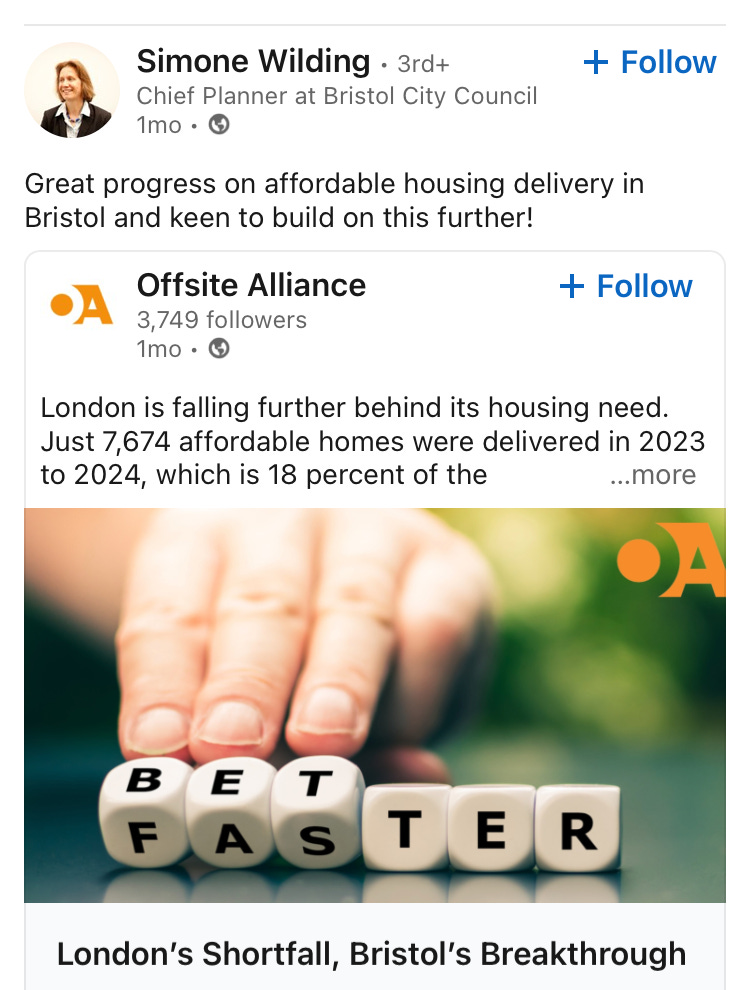
The Offsite Alliance article was written to trail an event it was co-hosting in Bristol with the Bristol Housing Festival, an organisation established with the help of former mayor Marvin Rees as a cross between a housing innovation think tank and a lobbying organisation for offsite construction methods. As well as making Bristol a key hub for for the modular construction sector and its associated network of developers, consultants, manufacturers and innovation advocates, founder Jeremy Sweetland now has a role at Bristol City Council leading a “transformation project” on Temporary Accommodation. The post’s framing of delivery mechanisms and public-private collaboration as the answer to the housing crisis, combined with quiet self-interest and the avoidance of deeper structural issues of financialisaton and speculation, is a classic of the LinkedIn genre and closer to PR than reality.
No surprise then that Andrew Smith commented underneath Wilding’s post, drawing another burst of enthusiasm from the Chief Planner:
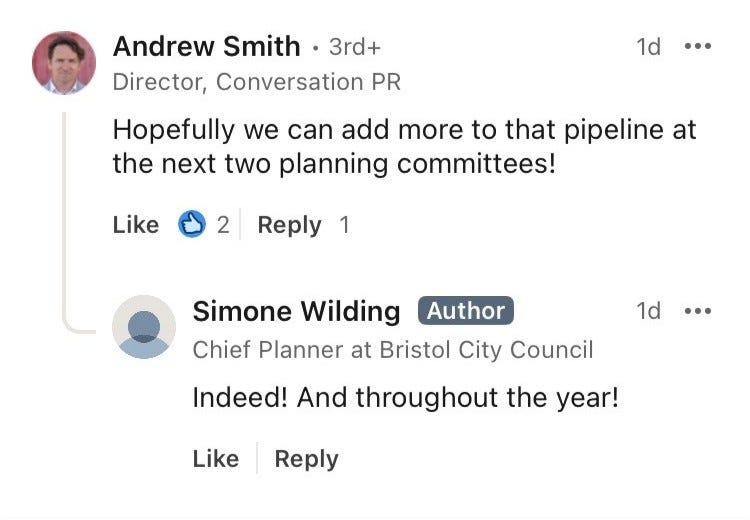
The first of the two schemes Smith was referring to was a 60-unit residential development in Redland that went to committee on February 24th (Conversation PR had been brought in following a deferral at committee the previous year). The other was Princess Street, which returned on March 11th following the earlier refusal. Though Smith didn’t speak himself at the Princess Street meeting, as mentioned previously, the ubiquitous Freddie Palmer from Meeting Place did.
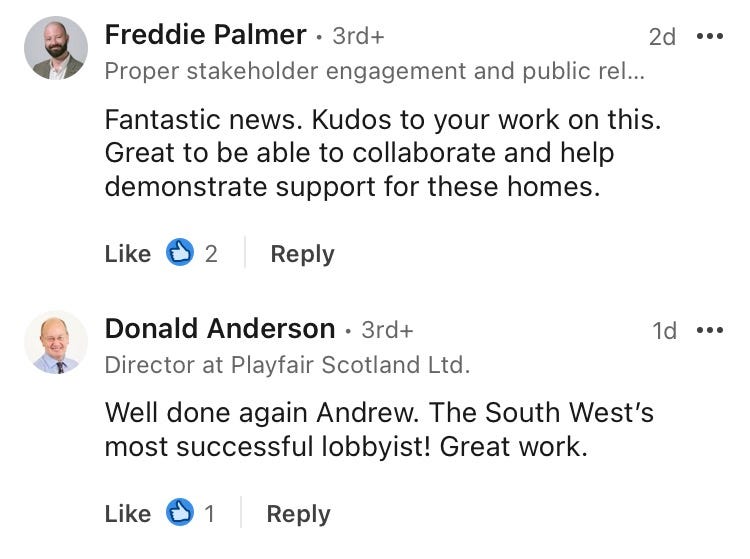
The man congratulating Smith as “The South West’s most successful lobbyist” is Donald Anderson, the former leader of Edinburgh City Council. Anderson set up Playfair Scotland – a public affairs and communications consultancy – in 2017. It also helps developers get contentious projects through the planning system by managing politics and public perception. Both businesses rely on the revolving door between the public and private sector, a fact that Conversation PR’s own website proudly boasts of: “Each consultant comes from a political, senior officer, consultation or media background. Working alongside founding director Andrew Smith are a number of highly experienced advisers, including former cabinet members for place and transport.”
City of the Future
The breakdown of boundaries between the local state and the development industry is epitomised in the Chief Planner’s warm immersion in the LinkedIn “development community”. But rather than simply being the personal approach of one senior council officer, this has been the culmination of a series of steps taken over the last decade since former mayor Marvin Rees entered City Hall with a mission to accelerate development and reposition Bristol as a growth city. From the introduction of the ‘Urban Living’ Supplementary Planning Document in 2018 – which effectively removed meaningful limits on tall buildings in central areas – to the 2023 restructuring of the planning service, which both diminished the council’s own urban design capacity and created the powerful Chief Planner role itself, an institutional environment has been consciously created to reduce obstacles for developers and investors. And these dynamics have only been reinforced by the direction of national policy under the current Labour government. The planning system at large has become an increasingly aggressive pro-development instrument, with housing delivery and investor confidence prioritised over local autonomy, design quality and civic character.
In Bristol, it’s increasingly apparent that the current viability challenges facing developers are going to be used to further reduce “friction” within the planning process. Alex Hearn, Bristol City Council’s Director of Economy of Place and Wilding’s immediate boss, recently told the Bristol Property Agents Association that “the world has changed”, adding:
“We need to think about the future of our next round of policies. Do we need to do anything about design guidance, or the way we apply the term ‘affordable housing’, to be a bit more pragmatic and creative?”
Whether the key actors within the local state are motivated by genuine ideological belief in this development model, or simply by the fact that career advancement and professional status depend on acting as loyal functionaries for capital and vested interests, is unclear. In their self-congratulatory and self-serving dreamworld, many still cling to the fiction that they are helping solve the housing crisis. While a broader populace vent their frustrations elsewhere online, struggling with chronic insecurity, surrounded by deteriorating public space, and a city that feels progressively less human and more disconnected from its past.
The LinkedIn class – fundamentally unmoved by questions of place, tradition, beauty, community or the inheritance of future generations – are helping shape a city that increasingly works for people like themselves and for a transient international population. The result is a socially fragile urban future: gated developments, mediocre architecture, atomised living and an alienating public realm. It’s hard not to think that their polished posts and comforting platitudes are going to become ever harder to sustain as rougher beasts slouch towards Bethlehem to be born.

